Posts

Bad Security Stories, Volume I: The Big 12 Still Has No Idea If Their Football Coach-to-Player Communications Were Actually Compromised

Your humble author is starting a new Sniff Wi-Fi blog series today: Bad Security Stories Yours truly may not be the second coming of Bruce Schneier -- though from what I've read of Schneier's I like his vibe -- but all these years of sniffing (and working in Wi-Fi in general) have led to me picking up a fundamental understanding of communications and data security. So let's blog about it! A  college football cheating scandal -- or at least, the potential for one -- was recently uncovered and resolved in a matter of three days . To steal a quote from a memorable-but-not-to-be-described-in-polite-company scene in the film Tommy Boy... hmm, that's a mystery. A quick primer: Throughout last year's college football season, there were several accusations of 'sign-stealing'. Sign-stealing involves comparing the hand signals, posters and other 'signs' used by football coaches to signal to their players what formation and/or orchestrated 'play' to ru...

These Wi-Fi Retry Percentages Are Too Dang High (no really... Retry% statistics are often inaccurate)

Image
  Show  of hands: Who here has seen Retry percentages above 90%? If you work with Wi-Fi, your arm is likely reaching skyward as if you're hiding Darrell Lea licorice from the kids. (Hope you wore deodorant today.) Juniper Mist is most notorious for it. Nyansa Voyance -- which is no longer a Wi-Fi thing -- used to do it too. Aruba Central even has a built-in alert for it. The problem is, 90% retries doesn't really exist (and of course, 100+% retries is impossible). When an AP repeatedly sends retransmitted frames (packets) to a Wi-Fi client -- and let's pause to point out that centralized WLAN management systems can only reliably know AP-to-client (not client-to-AP) retry statistics -- the AP will typically drop a packet before re-sending it so  many times that the wireless retry percentage would ever truly hit 90%. So why, then, do we see retry percentage near, at or above 90%? Because some (most?) Retry% calculations often use a denominator of successful  frames in...

At Least They Didn't Blame the Wi-Fi

Prime Video's stream of the 49ers-Cardinals NFL game received plenty of bad reviews on social media. While most of the negativity focused on stream quality, Wi-Fi largely escaped blame. There is one application type that confounds networks above all others, and it is live video. Pick your poison: voice, location tracking, on-demand video, cloud-hosted apps... None of them cause problems as consistently or predictably as the livestream. The issue is a simple one: broadcast vs. two-way. Packetized data networks are a two-way communication medium. Receiver must acknowledge sender. Live video has, since its inception decades ago, been a broadcast technology. Your television doesn't send anything to the local broadcast tower. Same with cable boxes. Same with satellite dishes. Pushing against this immutable scientific fact is commerce. Sports leagues see the billions of dollars being spent by streaming services, and they want some. Streaming services see the millions of eyeballs tun...

Chips, Glorious Wi-Fi 6E Chips!

Qualcomm, owners of the Atheros line of Wi-Fi radios, recently announced the availability of Wi-Fi 6E chips. Game onnnnnnn! 6 GHz Wi-Fi is here. Sort of... Qualcomm is selling Wi-Fi 6E (802.11ax w/ 6 GHz support) chips, but we don't yet know when enterprise-grade APs and mobile devices will begin supporting 6 GHz Wi-Fi. Chip-to-product timelines can vary. Wi-Fi 5 (802.11ac) saw enterprise WLAN vendors sell products only a few months after chip announcements. Wi-Fi 6 (802.11ax) saw the big vendors wait a year or more before introducing new AP models. A ton of concerns factor into a vendor's decision on when to develop, manufacture and market new AP technology. Vendors with small market share may be extra eager. Aerohive tried to boost their enterprise Wi-Fi profile by being a leader in Wi-Fi 6. On the other hand, some vendors' enthusiasm for new Wi-Fi hardware may be dulled by competing organizational initiatives. Aruba/HPE, for example, was veering f...

The Case for Upgrading to Wi-Fi 6

In a recent Sniff Wi-Fi post, your humble blogger argued that upgrading to Wi-Fi 6 is a fool's errand.  A number of respected WLAN professionals disagree with my argument. They believe that many organizations would be well-served to upgrade to Wi-Fi 6, rather than waiting for Wi-Fi 6E.  Why upgrade to a non-6 GHz standard, when 6 GHz Wi-Fi has now been approved? There are reasons... Making one's own counter argument is a tricky endeavor. The temptation to construct and incinerate straw men is powerful. There is a reason that the right to cross-examine is ingrained in the constitution of the United States of America, as part of the 6th Amendment: "...The accused shall enjoy the right... to be confronted with the witnesses against him; to have compulsory process for obtaining witnesses in his favor..." In layman's terms (and this has to be the first literal usage of the phrase "layman's terms" in the history of Sniff Wi-Fi), the above is refer...

Pi in the Sky, Part 1: WLAN Pi Basics

Image
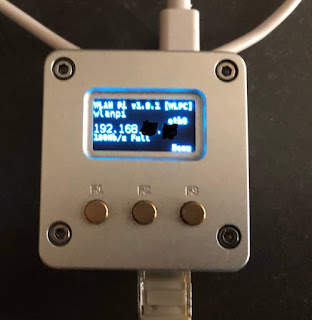
For some Wi-Fi professionals, WLAN Pi is the ultimate swiss army knife. For others, it is a byzantine puzzle.  Your humble blogger takes great pride in taking the complex and making it accessible. For the WLAN Pi, it starts with the Basics. The WLAN Pi project has been part of the WLAN professional community for several years. Conceived as a some-assembly-required kit project, the Pi has now grown beyond its humble roots. Your humble blogger has been fascinated by the WLAN Pi for some time, in large part because of the involvement of Jerry Olla. Jerry is a long time member of the WLAN community. He is based in Wisconsin, which makes me like him. He believes that the Milwaukee Brewers should not have received a publicly-funded baseball stadium, which makes me like him less. (I kid, I kid.) Jerry reached out to yours truly after a tweet expressing frustration at the WLAN Pi experience. Many Wi-Fi people have read, seen or been told about cool stuff that can be done with ...

The Risk and Reward of Wi-Fi 6 Upgrades

With 6 GHz Wi-Fi around the corner in the form of Wi-Fi 6E, upgrading to Wi-Fi 6 becomes a risky proposition. It was just over a year ago that your humble blogger heard the "news" about Wi-Fi 6 (802.11ax). The Samsung Galaxy 10 was on the market. It supports Wi-Fi 6. Our sales engineers were happy to inform us of the upgrade possibilities. Today's news is about a new technology, Wi-Fi 6E. It offers access to the 6 GHz frequency band, which is great. It is not available as a software upgrade from Wi-Fi 6 (as your humble blogger discovered recently ), which is not so great. "Future proofing" has always been elusive. As we are all experiencing right now, nothing can protect an organization from the whims of nature (human or otherwise). I wasn't saying "wait for 802.11n" in 2005 or "wait for 802.11ac" in 2011. If budget, manpower and leadership align, go for it. The reason your humble blogger says "wait for Wi-Fi 6E" today...

Five Facts About 6 GHz Wi-Fi

Image
Two pieces of important news hit the wire recently: the 6 GHz band was approved for Wi-Fi, and alcohol sales have skyrocketed .  Combine the two, and what do we get? A five-pack of Coors Light Cold Hard Facts about Wi-Fi in the 6 GHz frequency band. Editor's note: This is a relatively long post, but 6 GHz Wi-Fi is an undoubtably robust topic. If you have questions after reading this blog, comment below or contact Ben via email or Twitter using the information below, and Sniff Wi-Fi will address those answers in a future post. We may be knee-deep in a global pandemic, but that doesn't mean your humble blogger can't brew up a post on the topic of 6 GHz Wi-Fi. Wi-Fi professionals will soon have unlicensed frequency available in the 6 GHz band. Here, then, are five facts to know about Wi-Fi in the soon-to-be-available 6 GHz frequency band. Fact #1: The 6 GHz band adds 1,200 MHz of spectrum for Wi-Fi The Federal Communications Commission (FCC) is the federal ...

OFDMA Is the Only Part of Wi-Fi 6 That Matters (For Most Enterprises)

The new Wi-Fi 6 (802.11ax) standard offers several new technologies, but only one that really matters (for most enterprises): OFDMA. Have you heard about Wi-Fi 6?  (Or, at least, 802.11ax?)  If you work in or around networking or Wi-Fi, you probably have.  Your humble author has read about it in blogs, tweeted about it, streamed about it on Twitch and watched commercials about it on college football telecasts. It was the last thing -- the TV commercials -- that gave yours truly a double-take.  "Is Wi-Fi 6 that big?", I murmured to myself while taking in CDW's commercial for Cisco's Wi-Fi 6 gear.  Commercials on national sports broadcasts aren't cheap, so someone must be asking about it.  (Or at least think there's money in it.) The standard (technically an "amendment", not a full-blown IEEE standard) Wi-Fi 6 is based upon is 802.11ax, and according to the latest 802.11 Working Group timeline , 802.11ax won't be finished for several month...

Wasted Wi-Fi Q(-Tip)&(802.11)A: Transmit Power, Conducted Power and EIRP

Image
Last week's blog about Wasted Wi-Fi prompted some questions about AP transmit power in the enterprise.   Let's answer some of those questions by doing a little Q(-Tip)&(802.11)A, an exercise in which we watch a Q-Tip video before Answering a few questions about Wi-Fi. You've seen the Q(-Tip), now on to the A(nswer)s: Wasted Wi-Fi is all about APs and/or stations making inefficient use of a Wi-Fi channel.  When Wasted Wi-Fi happens, either data rates are lower than they should be, or Retry percentages are higher than they should be. The Q becomes, where do equivalent isotropically radiated power (EIRP), transmit power and conducted power fit in? The A is, higher data rates and lower Retry percentages tend to happen when signal-to-noise ratio (SNR) is higher, and higher EIRP/conducted power/transmit power leads to higher SNR. In other words, if you talk louder, then people hear louder.  When people hear louder, they have a better chance of being...

Are You(r APs' Transmit Power) Still Down? Raise 'Em Up

Image
Remember me? (lyrics NSFW) Too many enterprise Wi-Fi deployments experience Wasted Wi-Fi.   Wasted Wi-Fi is what happens when an enterprise wireless network offers users lower performance than it would under an optimal configuration. Today, the most common culprit of Wasted Wi-Fi is low AP transmit power.  So, if your AP transmit power config is Still Down, Raise 'Em Up. I've noticed a lot of Wasted Wi-Fi recently.  Situations where, given the distance, client density, and physical environment, the Wi-Fi should be faster.  These are situations where, irrespective of issues that may exist in the infrastructure equipment or design of the wireless LAN, client devices are getting worse performance than they should. By its definition, Wasted Wi-Fi lays entirely at the feet of those who configure enterprise Wi-Fi settings.  The good news is, that means Wasted Wi-Fi is solvable without expensive and time-consuming changes to the wireless LAN ...

How to Validate Hospitality Wi-Fi in Five Minutes Using Any Old Mac

Image
Do you own, manage, or provide technology services for a classy hotel?   Yes??   Then this blog's for you.   No, we are not going to reveal the secrets of luring wealthy clientele via watered-down booze and disreputable ladies.  Those things are obvious, and if they're not obvious you should ask a French person.  (One of my best friends is French, so I can say that...  I think.)   We are going to reveal how to quickly validate your other most important service -- Wi-Fi -- using free, built-in Mac software. The nice thing about providing Wi-Fi service at an upscale hotel (or other hospitality environment; convention centers, cruise ships, et al. count too) is that wealthy people hate to complain.  (Publicly, that is.  Privately that's all they do.)  The not-so-nice thing is that wealthy people are big fans of ghosting.  They will abandon your upscale hotel with the quickness if service of any kind dips ...