Using Bluetooth to Debunk the Dual 5 GHz Myth
What does Bluetooth have to do with 5 GHz Wi-Fi? Nothing. Bluetooth operates in the 2.4 GHz frequency band.
If you look in the right spot, however, Bluetooth can teach you something about 5 GHz Wi-Fi. Specifically, the Bluetooth 5.0 specification can teach you that Dual 5 GHz access points are a bad idea.
This blog's opposition to Dual 5 GHz access points (APs) is not news to long time readers. The 'Two Radios Are Better Than One (Unless They're Both 5 GHz)' blog post, which details how Dual 5 GHz APs (like Cisco 3800 Series APs, for example) make enterprise Wi-Fi less stable, is nearly three years old.
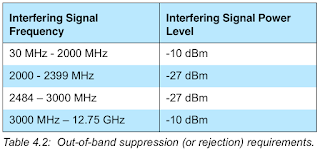
Today's re-stating of the pitfalls of dual 5 GHz radio APs is due to something I uncovered while reading about Bluetooth. I was reading the Bluetooth 5.0 specification in search of anything that might affect Wi-Fi when I happened upon this table:
***
If you look in the right spot, however, Bluetooth can teach you something about 5 GHz Wi-Fi. Specifically, the Bluetooth 5.0 specification can teach you that Dual 5 GHz access points are a bad idea.
This blog's opposition to Dual 5 GHz access points (APs) is not news to long time readers. The 'Two Radios Are Better Than One (Unless They're Both 5 GHz)' blog post, which details how Dual 5 GHz APs (like Cisco 3800 Series APs, for example) make enterprise Wi-Fi less stable, is nearly three years old.
Today's re-stating of the pitfalls of dual 5 GHz radio APs is due to something I uncovered while reading about Bluetooth. I was reading the Bluetooth 5.0 specification in search of anything that might affect Wi-Fi when I happened upon this table:

The middle rows of the table is most dramatic, showing that out-of-band RF activity can interfere with the 2.4 GHz band at signal levels as low as -27 dBm.
It is the top and bottom rows of the table that relate to Dual 5 GHz APs. Those rows show that RF signals further away from the 2.4 GHz band may interfere, if those interfering signals are above -10 dBm.
The problem with Dual 5 GHz APs is that two 5 GHz radios are within the same AP, and thus very close to one another. With two 5 GHz radios so close to one another, the chances of signals reaching levels above -10 dBm are likely; perhaps assured.
5 GHz channels 36 and 149 may seem far apart. In some respects, they are: Channel 36 is centered at 5.180 GHz and channel 149 is centered at 5.745 GHz, which means 565 MHz of frequency space between channels. The problem is that, when Dual 5 GHz APs are used, the close proximity of the two radios makes it so that busy Wi-Fi networks will be unstable. And nobody -- not users, not support folks, and not admins -- likes unstable Wi-Fi.
If you like my blog, you can support it by shopping through my Amazon link. Thank you.
Twitter: @Ben_SniffWiFi
Twitter: @Ben_SniffWiFi
ben at sniffwifi dot com

Interesting topic and article ! Aruba did an interesting benchmark on a Cisco dual 5GHz AP vs a dual band Aruba AP a while back. At that time it supported the claim of dimishing bandwith returns using dual 5GHz
ReplyDeletehttp://community.arubanetworks.com/t5/Technology-Blog/Does-the-Dual-5GHz-Story-Stand/ba-p/271720
I was some years back doing conference solutions using the large Xirrus arrays with 8 and 16 sectorized antennas. Their secret sauce was the alleged effective isolation between multiple sectors in the same housing. Having a central high capacity AP mounted high above the clients is however no longer the recommeded solution
I would agree. Definitely best to avoid having multiple AP radios in one "box".
DeleteThat chart is relative to 2.4 Ghz devices; it can't be extrapolated out to 5.8 GHz devices as you're using it. As best I can tell, you're reading those signal levels backwards. -10 dBm is a much stronger received signal than -27 dBm, though both are whoppingly strong. That chart perfectly illustrates the effect of band-pass filtering. Any 2.4 GHz device will be designed to reject signals outside of its operating range which is why that chart shows it takes a *stronger* signal above and below the 2.4 band to cause problems.
ReplyDeleteWhatever signal rejection characteristics a device such as a 5.8 GHz AP might have are specific to itself alone, not other equipment, not the depicted chart.
This post clearly uses Bluetooth insights to challenge the idea of Dual 5 GHz access points, showing how close‑proximity radios can destabilize busy Wi‑Fi networks and why dual 5 GHz radios are often a bad idea. The practical analysis of interference thresholds and real‑world design implications makes this a valuable read for network professionals.
ReplyDeleteai content detector
ai generated text detector
91A923B9
ReplyDeleteObrolan Acak
Випадковий чат
Discussion aléatoire
แชทแบบสุ่ม
Chat aleatoriu
Slumpmässig chatt
Bate-papo aleatório
Náhodný chat
Random Chat
This article insightfully highlights a lesser-discussed but critical aspect of RF coexistence—how proximity and out-of-band emissions can make dual 5 GHz access point designs more problematic than beneficial. By drawing a clever analogy from the Bluetooth 5.0 specification, it reinforces the importance of real-world interference behavior over theoretical spectrum separation. It’s a valuable reminder for network engineers that architectural decisions in wireless design must account for physical-layer realities, not just channel planning assumptions, especially in dense enterprise environments where stability matters more than raw throughput.
ReplyDeletePremium limousine booking
Nationally Recognised Safety Training
00BD638A
ReplyDeleteEdirne
Tunceli
Tekirdağ
Urfa
Manisa
Hakkari
Bayburt
Balıkesir
Trabzon
E5A77795
ReplyDeleteİnegöl
Saray
Tire
Akseki
Gemlik
Kandıra
Belek
Cide
Ayaş
FC6D1164
ReplyDeleteNusaybin
Ağva
Çayyolu
İnegöl
Kayapınar
Canik
Yüksekova
Gölcük
Gelibolu